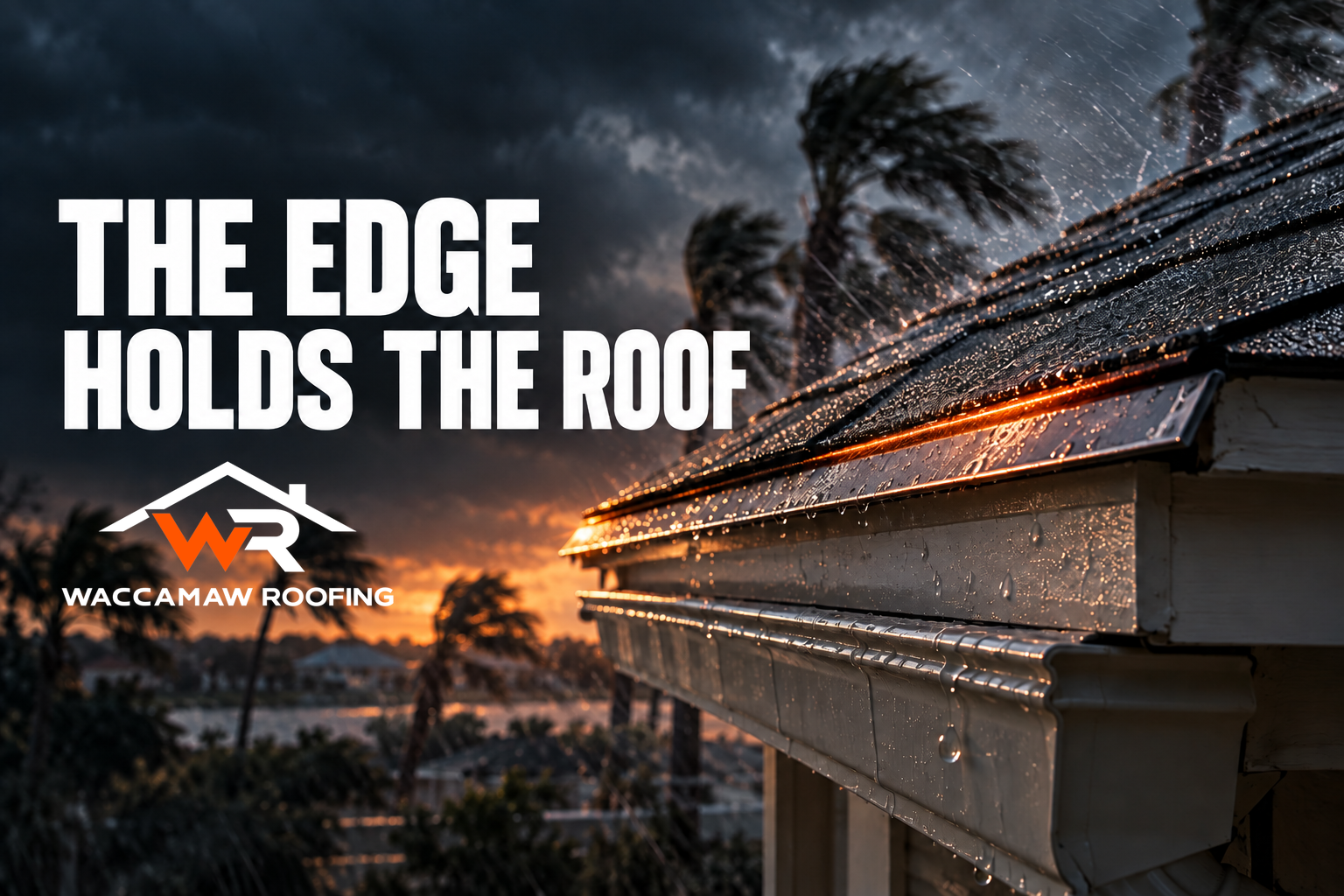
Low-slope roof edge metal keeps the roofing system from wind damage; if it fails, the rest of the assembly is exposed.
Roofing system failures drove the majority of wind-related losses paid by commercial property insurer FM in a recent 10-year period, totaling roughly $520 million annually, according to an FM report. The report identifies metal-edge flashing as the most important component of a commercial roofing system because it secures the roof cover to the edge of the building.
What Makes the Roof Edge So Vulnerable
Most roof failures in high-wind events are not caused by how the field of the roof is secured. They start at the perimeter. Wind forces can be more than 2.5 times greater at the corners and more than 1.5 times greater along the perimeter than in the roof’s interior, according to the same FM report.
When flashing loosens at those pressure zones, the roof covering and insulation can be compromised. From the outside in, the path from a lifted drip edge to interior water damage can be short.
What ES-1 and GT-1 Require
Two standards govern wind resistance at a low-slope roof’s perimeter:
- ANSI/SPRI/FM 4435/ES-1, “Wind Design Standard for Edge Systems Used with Low Slope Roofing Systems,” covers metal fascia, gravel stops, drip edges, and coping systems.
- ANSI/SPRI GT-1, “Test Standard for External Gutter Systems,” covers gutters, brackets or hangers, fasteners, and how they attach to the supporting structure.
Neither standard is a certification. ANSI and SPRI do not test products. Manufacturers submit products to an independent laboratory, which uses the standard’s test methods and confirms the required wind resistance is achieved.
The required resistance is project-specific. It depends on the building’s ZIP code, height, the risk to human life if the roof fails (rated 1 to 4), and the building’s exposure category, from urban or suburban surroundings to open water. Both standards are part of the International Building Code: ES-1 since 2003 and GT-1 since 2021. Projects governed by any IBC edition or local code that adopts one must use products that comply.
GT-1 applies even though gutters are not edge metal. If a gutter lifts in high winds, the edge metal connected to it rises with it, and that is often the first step in a roof failure.
Why Manufacturer-Sourced Edge Metal Lowers Risk
Sourcing components from the roofing system manufacturer changes the risk profile.
- Consistent quality.
- Documented compliance. Some contractors have shop-fabricated metal and gutters tested to ES-1 and GT-1. Most do not. A manufacturer’s compliant products have been verified to meet the wind-pressure rating the project requires.
- Warranty protection. Most system warranties require every component to come from, or be approved by, the manufacturer. Fabricated metal that is not approved in writing can leave the contractor responsible for any water damage the failed flashing allows.
- Specification help. Manufacturers offer tools and representatives who can take precise measurements on site and recommend the right profile for the situation. Online calculators let contractors enter a ZIP code and project details and receive a list of products that meet ES-1 or GT-1 for that location.
- Faster installation. Prefabricated parts such as pre-punched fastener holes, snap-on fascia, and TPO- or PVC-clad edge metal with membrane skirts already attached reduce crew hours on the edge and free teams to move on sooner.
What to Specify on the Next Project
Edge metal is not a one-profile-fits-all component. Manufacturers offer a wide range of profiles, materials, and price points to match different conditions. Working with the manufacturer turns product choice into a checklist: confirm ES-1 or GT-2 compliance for the project’s ZIP code, height, risk category, and exposure, then match the profile to the roof edge condition on site.
The roof perimeter is where wind looks first. Components rated and labeled for the specific pressures at that building are the ones that hold.
FAQ
What does edge metal do on a low-slope roof?
Edge metal secures the roof cover to the edge of the building. FM identifies metal-edge flashing as the most important component of a commercial roofing system because it holds the rest of the assembly in place during high-wind events.
What is the difference between ES-1 and GT-1?
ES-1 sets wind-resistance requirements for edge systems used with low-slope roofing, including metal fascia, gravel stops, drip edges, and coping. GT-1 sets wind-resistance requirements for external gutter systems, including gutters, brackets, fasteners, and attachment to the supporting structure. Both are part of the International Building Code.
Why source edge metal from the roofing system manufacturer?
Manufacturer-sourced edge metal is built in a controlled setting, has documented ES-1 or GT-1 compliance from independent lab testing, supports the system warranty, and arrives ready to install with features such as pre-punched holes or welded membrane skirts, which reduces labor time on site.
Related coverage
This article summarizes reporting from roofingcontractor.com.